Phone:
(701)814-6992
Physical address:
6296 Donnelly Plaza
Ratkeville, Bahamas.

Phone:
(701)814-6992
Physical address:
6296 Donnelly Plaza
Ratkeville, Bahamas.
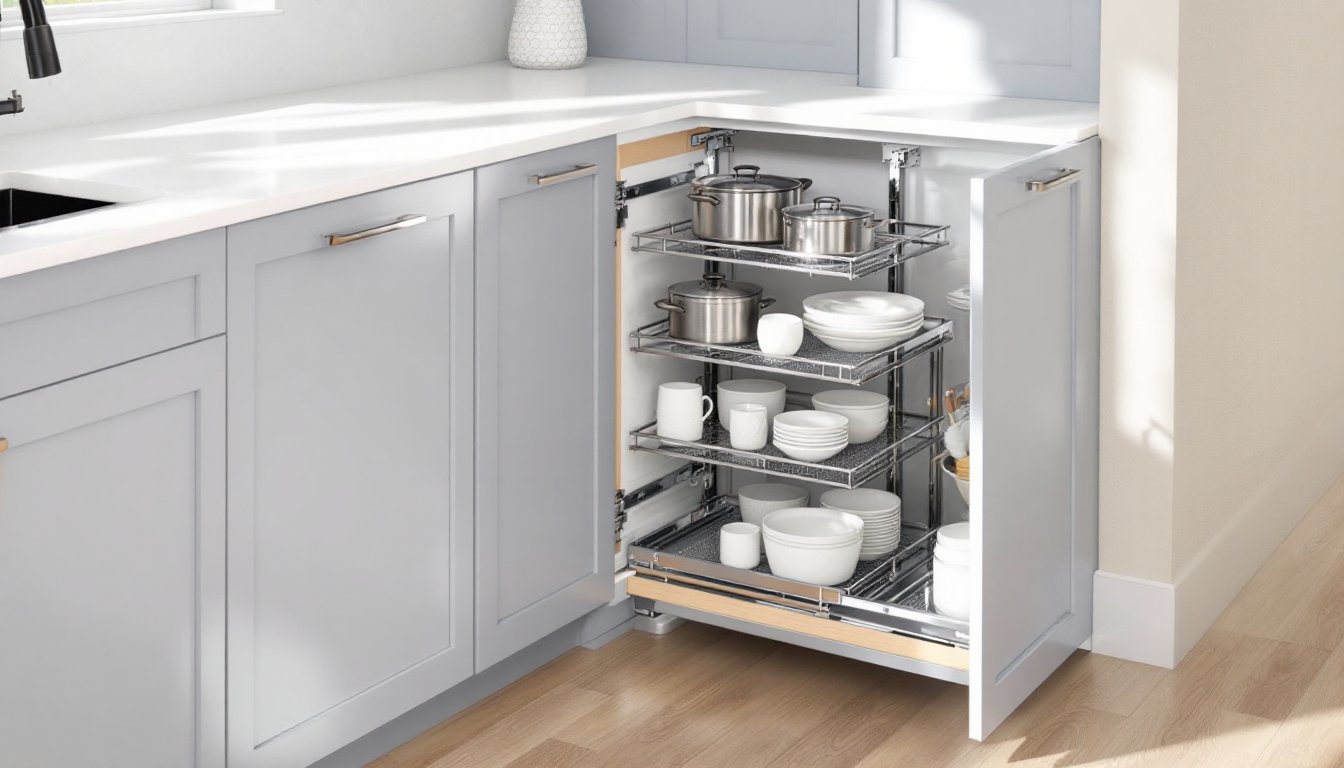
Kitchen corners are notorious for wasted space. Those awkward 90-degree junctions where base cabinets meet often become black holes for forgotten Tupperware lids and mystery spices. But with the right corner storage cabinet, that dead zone transforms into some of the most efficient square footage in the room. Whether renovating an existing kitchen or planning a new build, understanding corner cabinet options, and how to install them properly, can add significant usable storage without expanding the footprint. This guide walks through the main types, selection criteria, and installation considerations to help make the most of every inch.
Standard base cabinets are typically 24 inches deep, but when two runs meet at a corner, the resulting L-shaped void can measure 36 to 48 inches deep depending on layout. Without a purpose-built corner cabinet, much of that depth becomes unreachable, or worse, entirely inaccessible behind adjacent cabinet doors.
Corner storage cabinets solve this problem through mechanical solutions that bring contents forward or rotate them into reach. The payoff is tangible: a well-designed corner cabinet can provide 30 to 50 percent more accessible storage than leaving the space empty or using a standard blind cabinet.
Beyond capacity, corner cabinets improve workflow. Small kitchens, in particular, benefit from strategic corner storage that keeps cookware, pantry staples, or cleaning supplies within arm’s reach without crowding countertops or creating traffic bottlenecks. When planned correctly, they integrate seamlessly into cabinet runs and maintain consistent face-frame or frameless alignment with surrounding units.
Lazy Susan systems use circular shelves mounted on a central pole that rotate a full 360 degrees. They’re available in two main configurations: full-round (pie-cut doors that swing with the shelves) and kidney-shaped (D-shaped shelves that fit behind standard hinged doors).
Full-round Lazy Susans maximize storage but require 32- to 36-inch door openings, which can dominate small kitchens visually. Kidney-shaped versions fit behind two independent doors and work in tighter layouts, though they sacrifice some shelf real estate.
Shelf diameters typically range from 28 to 32 inches, with two or three tiers. Budget models use plastic trays on a fixed pole: better units feature ball-bearing swivels and adjustable shelves. These bearings make a noticeable difference in longevity, cheap Lazy Susans bind or tilt after a year of heavy use.
Lazy Susans excel for lightweight, frequently accessed items: spices, baking supplies, canned goods. They’re less ideal for heavy cookware, which can stress the center pole and cause wobble. Installation requires level base cabinets: even a slight tilt compounds with each rotation. Many woodworking projects include custom-built Lazy Susan frames for non-standard corner dimensions.
Pull-out drawer systems (sometimes called “magic corners” or “swing-out shelves”) use mechanical linkages that pull shelves forward and swing them out of the corner in a single motion. When the lead shelf extends, trailing shelves pivot into the doorway, exposing the entire cabinet depth.
These systems require 18- to 21-inch minimum door openings and work well in both base and tall cabinets. They’re engineered for heavier loads than Lazy Susans, quality units handle 75 to 100 pounds per shelf, making them suitable for pots, mixing bowls, and small appliances.
The trade-off is cost and complexity. Pull-out systems typically run $200 to $500 per unit (hardware only, not including cabinetry), compared to $50 to $150 for a basic Lazy Susan. They also have more moving parts: slides, pivots, and mounting brackets that must be precisely aligned during installation. Misalignment by even 1/8 inch can cause binding or uneven extension.
Pull-out systems shine in high-use kitchens where quick access to deep storage justifies the investment. They’re particularly popular in corner kitchen cabinet designs that prioritize accessibility over budget.
Diagonal corner cabinets (also called “angle front” cabinets) eliminate the 90-degree corner by installing a single cabinet at a 45-degree angle. The door faces into the room rather than down one wall, creating a more open feel and easier access.
This design works best in kitchens with at least 10 feet of clearance from the corner to allow comfortable door swing. The angled face typically measures 18 to 24 inches wide, with the cabinet depth tapering from 24 inches at the sides to 36 inches or more at the deepest point.
Diagonal cabinets often feature fixed shelves or simple pull-out trays rather than rotating mechanisms. They’re easier to build and install than Lazy Susan or pull-out systems, making them a good choice for DIYers comfortable with basic cabinet assembly. The main drawback is visual impact, the angled door breaks up cabinet lines and can look awkward in very small kitchens where wall space is precious.
They’re ideal for storing items that don’t need frequent access, such as seasonal cookware or bulk pantry goods. Some homeowners convert the lower portion to a wine rack or appliance garage, taking advantage of the depth without fighting to reach the back corners.
Start by measuring the actual corner, not just consulting floor plans. Use a tape measure to verify the distance from the corner to adjacent appliances, door swings, and traffic paths. A Lazy Susan requires enough clearance for doors to open fully without hitting refrigerators or ranges, typically 48 inches minimum from hinge to obstruction.
Consider what will be stored. Heavy cookware and small appliances favor pull-out drawer systems with robust slides. Pantry items, dishes, and lightweight supplies work well on Lazy Susans. Infrequently accessed storage (holiday platters, extra mixing bowls) can go in simpler diagonal cabinets with fixed shelves.
Budget matters, but so does longevity. A $400 pull-out system that lasts 15 years and prevents daily frustration beats a $60 Lazy Susan that binds, tilts, or breaks within two years. Quality indicators include ball-bearing swivels, soft-close mechanisms, and steel (not plastic) mounting brackets.
Match the cabinet construction to your existing kitchen. Face-frame cabinets (common in traditional and transitional styles) have a 3/4- to 1-inch frame around the door opening that affects how corner systems mount. Frameless (European-style) cabinets offer slightly more interior space but require different hinge and slide specifications. Mixing styles creates gaps and misalignment.
Finally, factor in installation complexity. Lazy Susans are straightforward for experienced DIYers. Pull-out systems demand precision, if you’ve never installed euro slides or adjusted multi-point hinges, budget for professional installation or plan extra time for trial and error. Diagonal cabinets fall in the middle: basic carpentry skills suffice, but cutting the angled face and scribing it to walls takes patience.
Level and plumb come first. Corner cabinets amplify any tilt in base cabinets, a Lazy Susan on an unlevel floor will drag or jam. Use shims under base cabinets to achieve level in both directions (front-to-back and side-to-side) before securing them. Check with a 4-foot level: a small torpedo level won’t catch gradual slopes.
Pre-assemble as much as possible. Install Lazy Susan poles, mounting plates, and shelves before setting the cabinet in place. For pull-out systems, attach the mounting rails and test the action on a workbench. Trying to install hardware in a cramped corner wastes time and increases error.
Fasten to wall studs, not just drywall. Corner cabinets are deeper and heavier than standard units, especially when loaded. Locate studs with a stud finder and use 2½- to 3-inch cabinet screws through the mounting rail. If studs don’t align, install a 1×3 ledger board across multiple studs, then screw the cabinet to the ledger.
Leave room for adjustments. Don’t overtighten screws during initial positioning. Mount the cabinet loosely, check alignment with adjacent units, then tighten incrementally. Pull-out systems often include slotted mounting holes for fine-tuning, use them.
Safety gear is non-negotiable. Wear safety glasses when drilling overhead or cutting cabinet panels. Use work gloves when handling sheet goods (plywood edges are sharp), and a dust mask if cutting or sanding MDF or particleboard core materials.
If the corner cabinet ties into a structural modification, removing a section of wall, relocating plumbing, or adding electrical outlets, check local building codes. Most jurisdictions require permits for work that affects load-bearing walls or in-wall utilities. A non-permitted modification can complicate home sales or insurance claims.
For complex installations involving custom cabinetry or pull-out systems with weights exceeding 100 pounds, consider hiring a cabinet installer for at least the corner unit. They’ll ensure the mechanicals align properly and won’t void manufacturer warranties by incorrect mounting. The investment typically runs $100 to $200 for a single corner cabinet and can prevent costly do-overs.