Phone:
(701)814-6992
Physical address:
6296 Donnelly Plaza
Ratkeville, Bahamas.

Phone:
(701)814-6992
Physical address:
6296 Donnelly Plaza
Ratkeville, Bahamas.
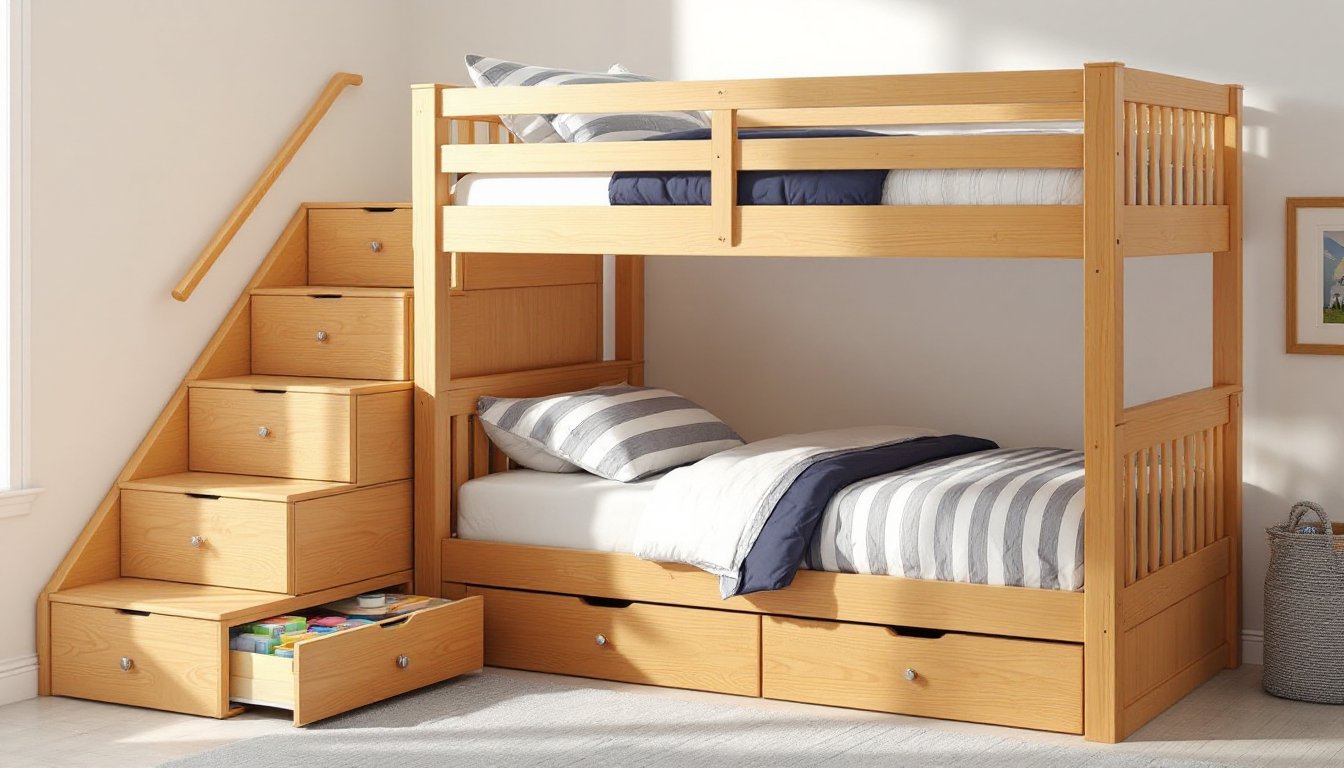
Kids’ bedrooms, guest rooms, and studio apartments share a common problem: vertical space goes unused while floor space disappears fast. A bunk bed with storage stairs addresses both issues at once, turning what’s normally just a ladder into functional storage while keeping the sleeping area elevated. Unlike standard bunk beds with vertical rungs, these designs incorporate drawers, cubbies, or open shelving into each stair tread. The result? Extra square footage for toys, books, linens, or off-season clothes without adding another piece of furniture to an already cramped room.
Traditional bunk bed ladders are nothing more than vertical or angled rungs attached to the frame. They serve one purpose: getting a person up and down. Storage stairs, by contrast, function as a staircase with built-in drawers or shelving integrated into each step.
Each tread typically sits atop a box or drawer unit, creating usable storage volume beneath the walking surface. Most designs feature three to five steps, with each step housing a drawer that pulls out from the front or side. Some models use open cubbies instead, which work well for bins or baskets.
The staircase itself is wider and deeper than a ladder, usually 18–24 inches wide and 10–12 inches deep per tread. This footprint eats more floor space than a ladder (which might be just 12 inches wide), but the trade-off is stability, safety, and storage capacity. The structure is typically built from ¾-inch plywood or solid pine, reinforced with cleats and corner braces to handle the load of both climbing and stored items.
Because the stairs create a blocky profile, they’re almost always placed perpendicular to the bed frame rather than parallel. This orientation lets the stairs double as an architectural element, sometimes functioning as a room divider or visual anchor point in open layouts.
Climbing a vertical ladder in the dark or while half-asleep is a recipe for slips, especially for younger kids or anyone carrying a book, tablet, or stuffed animal. Storage stairs eliminate that risk. Each step offers a full-depth tread, typically 10–12 inches, giving climbers a stable surface for their entire foot, not just their toes.
Handrails or side panels are easier to incorporate into stair designs than ladder designs. Most commercial and DIY plans include a railing on at least one side, anchored to wall studs or the bed frame itself. For families with toddlers or elderly guests using a loft setup, this makes the difference between confidence and hesitation.
Stairs also distribute weight more evenly across the frame. A ladder concentrates force on two narrow rails, while stairs spread the load across multiple cleats, stringers, and drawer boxes. That means less sway, less flex, and fewer midnight creaks when someone climbs up or down.
A standard twin bunk bed takes up roughly 42 × 80 inches of floor space. Add a dresser (36 × 18 inches) and a bookshelf (24 × 12 inches), and you’ve consumed most of a 10 × 10-foot room. Storage stairs collapse all three pieces into one footprint.
Four stair drawers typically yield 10–15 cubic feet of storage, roughly equivalent to a small dresser. That’s enough for a week’s worth of clothing, a seasonal wardrobe swap, or a collection of board games and craft supplies. Some builders add a fifth “landing” drawer at the top step for even more capacity.
Because the stairs are structural, they don’t need to sit against a wall. This opens up layout options: place the bed in the center of the room with the stairs facing the door, or tuck the stairs into a corner to free up wall space for a desk or reading nook. The flexibility often makes small rooms feel bigger, not more cluttered.
Solid wood (pine, oak, or maple) remains the most popular material for custom builds. Pine is affordable and easy to work with hand tools or a circular saw, but it dents easily, plan on edge-banding or corner guards if kids will be rough on the stairs. Oak and maple cost more but handle decades of use without showing wear. Expect to pay $4–$7 per board foot for pine, $8–$12 for red oak, and $10–$15 for hard maple, depending on regional supply.
Plywood is the go-to for DIYers building from scratch. A single sheet of ¾-inch cabinet-grade birch plywood runs $60–$90 and yields enough material for drawer boxes, treads, and side panels. Use hardwood edge banding on visible plywood edges to hide the laminated core, it’s a 10-minute step that elevates the finished look.
Modern and minimalist designs favor white or gray painted MDF for drawer fronts, paired with birch plywood carcasses. MDF takes primer beautifully and costs less than hardwood, but it’s heavy and doesn’t hold screws as well in thin sections. Always pre-drill screw holes and use confirmat screws or pocket screws for joinery.
Industrial-style builds incorporate metal drawer slides and pipe railings. Full-extension ball-bearing slides (rated for 100 lbs) cost $12–$25 per pair and make drawers easier to access than traditional side-mount slides. Black iron pipe handrails give a loft-bed aesthetic and handle lateral loads better than wood dowels.
For families interested in modifying existing furniture, projects featured on IKEA Hackers demonstrate creative ways to combine stock items like Trofast bins or Kallax units into stair assemblies. These approaches save time on cutting and finishing but require careful measurement to ensure parts align with standard bed frame heights.
Start by measuring the ceiling height. Most building codes require a minimum of 30 inches of clearance between the top bunk mattress and the ceiling. Standard bunk beds place the upper mattress platform at 60–65 inches off the floor. Add a 6-inch mattress, and you’re at 66–71 inches total. In a room with 8-foot ceilings (96 inches), that leaves 25–30 inches of headroom, tight, but workable. Vaulted or 9-foot ceilings give much more breathing room.
Next, consider weight capacity. Commercial bunk beds are typically rated for 200–250 lbs on the upper bunk and 400 lbs on the lower. Storage stairs add weight and complexity, so look for beds with extra crossbars or center supports under the upper platform. DIY builders should use 2×6 or 2×8 framing for the upper bunk if adults will be sleeping there. Always check that drawer slides are rated for at least 75 lbs per drawer to avoid sag over time.
Drawer configuration matters more than most buyers expect. Front-facing drawers are easy to access but require clearance in front of the stairs, usually 24–30 inches. Side-facing drawers fit tighter spaces but can feel awkward to open if the stairs are placed in a corner. Some designs use a mix: front drawers on lower steps and side drawers at the top.
Finally, think about long-term use. Will the bunk bed convert into two twin beds when kids get older? Some designs feature stairs that detach or serve as freestanding storage cubes. Others are permanently integrated. If resale or reconfiguration is a priority, choose a modular design with bolted connections rather than glued and doweled joinery.
Pre-made bunk beds with storage stairs from retailers like Wayfair, Pottery Barn Kids, or Ashley Furniture cost $800–$2,500 depending on size, material, and finish. These units arrive flat-packed with cam-lock hardware and pre-drilled holes. Assembly typically takes 3–5 hours for two people with basic hand tools, an Allen wrench, screwdriver, and rubber mallet.
The upside? No measuring, no cutting, and a finish that’s hard to replicate at home without a spray booth. The downside is limited customization. Drawer sizes, stair placement, and overall dimensions are fixed. If your room has an odd layout or non-standard ceiling height, off-the-shelf units may not fit well.
DIY builds offer total control but demand intermediate carpentry skills. You’ll need a miter saw or circular saw, drill, pocket-hole jig, and clamps. For anyone comfortable following detailed plans, sites like The Handyman’s Daughter often feature step-by-step tutorials for similar furniture projects. For storage stair plans specifically, free woodworking plans walk through cut lists, assembly sequences, and hardware recommendations.
Material costs for a DIY twin-over-twin bunk with storage stairs typically run $400–$700, assuming you already own basic tools. Plan on 20–30 hours of work spread across a weekend or two. Budget extra time for finishing, sanding, priming, and painting can double your timeline if you want a professional look.
Safety note: Whether building or buying, make sure the upper bunk has guardrails on all open sides, with no gaps wider than 3.5 inches (per CPSC guidelines). Use 3-inch structural screws or ½-inch bolts for all load-bearing connections, not just finish nails or staples. Always anchor the bed frame to at least two wall studs using L-brackets if the design is tall or top-heavy.
Permits aren’t usually required for furniture, but if you’re building a loft bed with a desk or play area underneath, check local codes, some jurisdictions treat elevated sleeping platforms above a certain height as structural modifications, especially in rental units or condos with HOA rules.
